
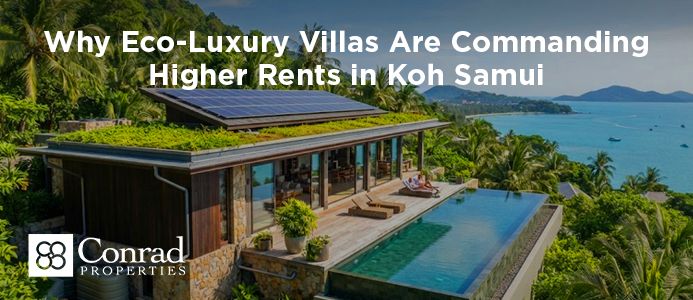
Villas on Koh Samui with solar power, rainwater harvesting, and sustainable design features are commanding higher nightly rental rates and occupancy than comparable villas without them. This isn't a luxury-only trend - it applies to villas across the price spectrum, and it's reshaping what both renters and buyers are looking for on the island in 2026.
Two things are happening at once on Koh Samui. First, electricity costs on the island are high relative to mainland Thailand, and villa rental guests increasingly notice and ask about running costs - especially longer-stay guests and digital nomads who might be paying utilities directly or watching a host's pricing structure closely. Second, the profile of the average Samui renter has shifted. Fewer are one-week package tourists; more are remote workers, wellness travellers, and longer-stay digital nomads who actively search filters like "solar," "eco villa," or "sustainable" when booking.
Booking platforms have also started surfacing sustainability badges and filters more prominently, which means a villa with genuine eco-credentials is now more discoverable - not just more appealing once found.
The result: villas with solar power and water-efficiency systems are seeing better booking conversion, longer average stays, and the ability to hold rates during shoulder season when non-eco villas are forced to discount.
The term gets used loosely, so it's worth being specific about which features actually move the needle for renters and appraisers, versus which are marketing dressing.
Features that meaningfully affect rental performance:
Features that are nice-to-have but rarely change rental performance on their own:
It's easy to assume eco-features are the preserve of high-end, branded villas - and much of the current market conversation treats them that way. But the reality on the ground is more useful for a wider range of buyers and renters than that framing suggests.
A mid-budget villa with a well-sized solar setup and decent water efficiency can compete on running costs and guest appeal against a larger villa without those features - sometimes closing the gap on booking rates almost entirely. For owners working with tighter renovation or build budgets, solar in particular tends to be the highest-return single addition: it's a visible, explainable selling point in a listing, and it produces a measurable saving that can be passed on to guests or kept as extra margin.
This matters because Koh Samui's fastest-moving sales segment right now is not the top end of the market - it's the mid-range. Smaller, well-located villas with efficient running costs are selling and renting quickly, and eco-features are increasingly part of what makes them competitive, not a luxury add-on reserved for beachfront estates.
While every villa's performance depends on location, management, and seasonality, the pattern across the current Samui rental market is consistent: eco-equipped villas are achieving noticeably better shoulder-season occupancy and are more resistant to the rate-cutting that non-eco properties often resort to when demand softens. The advantage tends to show up less in peak-season pricing - where a well-located villa rents regardless - and more in the quieter months, where differentiation actually decides who books.
For owners, the practical takeaway is that solar and water-efficiency investments tend to pay back through occupancy stability and reduced running costs more than through dramatically higher nightly rates. It's a resilience premium as much as a price premium.
If you're evaluating a villa purchase on Koh Samui, whether for personal use, rental income, or both, a few practical questions are worth asking regardless of budget:
For sellers and owners considering upgrades before listing a villa for sale or rent, solar and water efficiency are generally the two highest-leverage investments - they're explainable in a listing, verifiable to a buyer's or renter's due diligence, and directly tied to the running-cost conversation that increasingly drives booking and purchase decisions on the island.
It's worth breaking this down by the kind of property, since "eco-luxury" gets applied to very different villas in practice.
Beachfront and hillside luxury villas are where branded and boutique developments are leaning hardest into eco-positioning - solar arrays sized to run a villa fully off-grid during daylight hours, rainwater systems feeding pools and gardens, and passive cooling built into the architecture from the ground up. These villas market sustainability as part of a broader premium experience, alongside concierge services and resort-style amenities. Browse our current beachfront collection and sea view villas for sale to see this in practice. Here, eco-features are one part of a wider luxury story, not the whole pitch.
Mid-range detached villas - the segment that's actually moving fastest on Samui right now — see a more direct, practical version of the same trend. A 3-bedroom villa with a modest but properly sized solar system doesn't need a marketing story about sustainability; it just runs cheaper, stays cooler with less AC strain, and shows up better in searches where renters filter by eco-friendly listings. For owners in this bracket, the return on a solar investment is usually the clearest and fastest of any renovation choice available. You can explore our full range of villas for sale in Koh Samui to compare options across this segment.
Older villas without eco-retrofits are increasingly the properties losing ground in shoulder-season bookings, regardless of location or interior quality. Guests comparing similar villas at similar price points are starting to treat running-cost transparency and eco-features as a tiebreaker, and sometimes as a primary filter.
Does adding solar power to a villa in Koh Samui actually pay for itself? For most detached villas with meaningful AC load, a properly sized solar system typically pays back through reduced running costs within a few years, and continues to support stronger rental performance afterward - particularly during shoulder-season months when guests are comparing similar listings on cost and comfort.
Do renters really search for eco-friendly villas on Koh Samui, or is this overstated? Booking behavior on the island has shifted toward longer-stay guests, remote workers, and wellness travellers, and these renter types are more likely to actively filter for sustainability features or ask about running costs before booking, compared to short-stay package tourists.
Is an eco-luxury villa only relevant for high-budget buyers? No - solar power and water-efficiency upgrades tend to have the clearest return on investment for mid-budget villas, since they directly offset a guest's biggest recurring concern (AC running costs) without requiring the larger capital outlay associated with beachfront or branded developments.
What eco-feature should a Koh Samui villa owner prioritize first? Solar power sized to the villa's actual air-conditioning load is generally the single highest-leverage investment, followed by rainwater harvesting and passive cooling design, which support the same cost and comfort story without needing extensive retrofitting.
Koh Samui's strict low-density building regulations have already made the island a relatively scarce, protected market compared to more heavily developed destinations. Eco-features are becoming a parallel form of scarcity value - not because they're rare in absolute terms, but because they address a cost and comfort concern that every renter and owner on a tropical island shares. A villa that manages its running costs well, regardless of its price point, is simply an easier property to rent, live in, and eventually sell.
For buyers and owners across the market - not just at the top end - that's a trend worth paying attention to now, while it's still a genuine differentiator rather than an expected baseline.
Whether you're searching for a villa that's already built for efficient, sustainable living, or you're an owner weighing an eco-upgrade before your next sale or rental season, Conrad Properties can help you find the right fit. Browse our current villas for sale in Koh Samui or get in touch with our team for a conversation about what an eco-upgrade could mean for your property's performance.
Thinking of investing in Koh Samui property in 2025? Discover the latest trends, forecasts, and prime locations for property investment in this tro...
Branded residences are Koh Samui's fastest-growing luxury trend — but independent villas still dominate the market and sell faster at alm...
Koh Samui vs Phuket: Discover why Samui's limited land, booming luxury villa market, and high rental yields make it Thail...
Dreaming of a custom villa in Koh Samui? Our ultimate step-by-step guide covers land, legalities, design, and construction. Build your paradise tod...
When buying property in Koh Samui or even Thailand in general, foreigners face a major restriction—they cannot own land in their name or have...
Discover the ultimate guide to buying property in Koh Samui with our expertise as the island's leading real estate agency. Explore luxurious vi...
We’ve uncovered the 10 best Koh Samui properties for sale under ฿10 million THB—including modern pool villas and high-yield condos. Thi...





Leave a reply